You won’t find out by watching what someone does at work. You find out by watching what happens the moment the pressure stops. Jason Alan Bohrer, author of Resilient: The Seven Pillar System for Peak Performance on Demand, works with founders and executives who look sharp from the outside and are running on empty underneath.
His read on the question is blunt. The traits a company rewards most, skipping vacations, answering messages after midnight, staying unshakeable under any deadline, are often the surest sign that someone’s nervous system stopped recovering a while ago.
Bohrer built his whole framework around one line he keeps coming back to: “Your performance ceiling will never rise higher than your recovery floor.” That’s not a slogan. It’s a description of how the nervous system works under load, and it means a company can spend a decade rewarding the wrong behaviors in its highest performers and never see their burnout coming ahead of time.
What’s the Real Difference Between Drive and Dysregulation?
Bohrer’s answer starts with how similar the two feel from the inside. Dysregulation makes a person faster, more reactive, and always in motion. For a while it produces real results, which is exactly why it gets mistaken for ambition. A dysregulated nervous system is running what Bohrer calls a threat protocol. “Drive moves you toward your vision. Dysregulation moves you away from threat.”
The two can look identical in a quarterly review and feel identical at 11 p.m. with an inbox still open, but Bohrer says they come from different neurochemistry entirely, with different ceilings attached. A workplace that calls hyperactivation “hustle” and promotes the person who never seems to slow down is training its whole staff to chase the wrong signal. Nobody sets out to reward burnout. Companies just can’t always tell the difference between a person moving toward something and a person running from it.
The Behaviors Every Company Rewards Are Warning Signs
Bohrer lists these the way a physician lists symptoms: never taking a day off, treating sleep like a negotiable line item, staying available at any hour. That last one reads as commitment on a performance review. A leader who performs well only under pressure isn’t showing strength. That leader needs the adrenaline and the company has mistaken a dependency for a virtue.
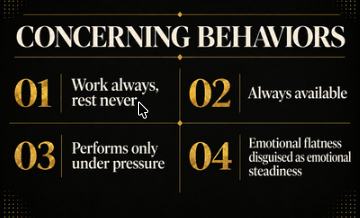
The hardest warning sign to spot is composure itself. A regulated leader who’s calm under fire and a dysregulated leader who has gone emotionally flat can look the same in a meeting. “One is a resource. The other is a liability in disguise.”
The hardest warning sign to spot is composure itself.
Why Does Pushing Through Feel Like a Winning Strategy?
It works. But it isn’t a strategy you can rely on long-term. “Early success with a bad strategy convinces you that the strategy is sound.” The nervous system has real resilience built into it, so a person can draw against their reserves for months, sometimes years. Along the way they get promoted, praised, and reinforced, which means the feedback they’re getting is precisely backwards.
Bohrer frames the tradeoff in blunt terms. “It is a withdrawal, not a deposit.” Most high performers, in his experience, treat pushing through like income instead of a loan. A person can only make withdrawals for so long before the account collapses. The damage doesn’t show up on a predictable schedule the way it would in a machine. It accumulates quietly, and the most dangerous stretch is usually one where everything still looks fine from the outside, right up until it doesn’t.
How to Reset Your Nervous System
Bohrer’s advice on resetting your nervous system doesn’t start with therapy or a sabbatical. It starts with a full stop, two to three minutes with no phone, no productivity goal, and no agenda besides letting the nervous system register that there’s no threat in the room. “Your body knows.” Bohrer says it will demand a reckoning if it keeps getting ignored.

The mechanics Bohrer teaches are almost absurdly simple. Here’s the process:
- Soften your eyes.
- Widen your peripheral vision.
- Press your thumbnail gently into the pad of your middle finger, which prompts belly breathing instead of the shallow chest breathing most people default to under stress.
- Inhale for four counts, hold for two, and exhale for six.
- Repeat three times.
Nothing about a person’s workload changes in those seconds. The inbox is still full and the deadline hasn’t moved. What changes is the operating system underneath it, and that’s the only place real capacity ever gets rebuilt.
None of this shows up on a quarterly report. A company can watch its best people make the same withdrawals over and over and read every one of those wins as evidence the strategy works, right up until there is nothing left for their best people to give.