The whole issue on one page, ready to print or save as a PDF to read offline.
October 2026
Kyle McDowell on accountability versus ownership, plus Jürgen Dauk, Shep Hyken, Jason Bohrer, Jimmy Burroughes, Tanya Anne Chavez, Art Serna, Neil Thubron and Mason Duchatschek.
Keep Your Guard Up
Mason Duchatschek
Mike Tyson famously said, “Everybody has a plan until they get punched in the face.”
One of the best ways to avoid that punch is simple: Keep your guard up.
In UFC fights, one of the last things a referee tells both fighters is to protect themselves at all times. The fighters already know this. Their coaches have drilled it into them for years. Yet fighters still get tired, overconfident, or careless. They drop their guard, and sometimes that mistake invites the punch or kick that ends the fight.
Business leaders need the same reminder.
Companies put safeguards in place for a reason. Drug screening, pre-employment assessments, background checks, hiring standards, and safety procedures are all designed to reduce risk before it becomes an expensive problem.
Then pressure builds.
Hiring needs to move faster. A process feels inconvenient. A safeguard costs money. Someone points out that the company has not had a problem in years.
So the guard comes down.
The danger is that many protections look unnecessary when they are working.
Stop drug screening and the savings may look smart until an impaired employee causes an accident.
Lower hiring standards and the open position gets filled faster, but the wrong employee drives away customers or your best people.
Stop screening for honesty and reliability, and the savings can disappear quickly through theft, time abuse, or questionable claims.
These decisions often get presented as cost-cutting. Sometimes they are simply risk-shifting.
The company saves a little money or time today while accepting the possibility of a much higher cost tomorrow.
Leaders should absolutely question wasteful processes. But there is an important difference between removing waste and removing protection.
Before eliminating a safeguard, ask a simple question: Has this process become unnecessary, or has it been doing its job so well that we have forgotten what it protects us from?
Professional fighters hear the same warning before every fight because knowing something is not the same as consistently doing it.
Business leaders are no different.
Keep your standards high. Know which safeguards matter. Do not let convenience, confidence, or short-term savings convince you to expose the company to a risk you already know how to prevent.
Keep your guard up. Protect your business at all times.
Why Does Every Decision Still Have to Go Through the CEO?
Jürgen Dauk
Every decision lands on the CEO’s desk because the company was built to send it there. Nobody has redesigned it since. Approval chains, management layers, and reporting cycles are all working exactly as built. They were built for control. Speed was never the goal.
Jürgen Dauk, author of The Leadership Operating System, spent more than 25 years inside Oracle, OpenText, and Avaya watching that play out. He treats slow decision-making as a design flaw, not a discipline problem.
His diagnostic takes about a minute. How long does it take you to change direction? How much middle management are you carrying to get a decision communicated? Are you spending more energy policing KPIs than running experiments? The uncomfortable part of his answer is where the design comes from.
Dauk’s view is that most command-and-control structures survive on fear:
fear of losing control
fear of missing the number
fear of disappointing shareholders
A leader operating from there will talk about transformation while keeping it strictly cosmetic.
When a System Rewards the Wrong Things
It looks like a company where everyone is working hard on the wrong scoreboard. Sales blames marketing and marketing blames sales. Each side can prove it’s doing its job, because “everybody’s defending their own KPIs instead of moving the needle.” The system isn’t broken in the sense of malfunctioning. The system rewards people for defending their turf.
Then there’s the “trust math,” which Dauk finds funny in the way a thing can be funny and expensive at the same time. A company hires a capable person in their forties, someone who has bought a house, taken on a mortgage, and decided whether to have children. “You don’t trust them to make a decision worth a thousand bucks,” he says, describing a policy most companies would defend as prudent financial governance.
What that policy hides is the price of waiting. A bad decision is visible. Somebody made it. There may be a postmortem. A decision that sits for six weeks is harder to see, even when the delay costs real money. An executive who has never been penalized for being slow has no reason to get faster.
Years ago I heard the story of Lee Iacocca asking his engineers at Chrysler how long it would take to build a convertible prototype. They came back with months for this and that, the standard engineering answer. He told them to take a LeBaron, cut the lid off, and put a ragtop on it. That was around 40 years ago, and I’m not convinced most companies would move faster today.
What Happens When 12,000 Employees Report to Two Managers?
Dauk points to a nursing company running almost 12,000 people with two managers. Teams cap at 12, and when a team outgrows that it splits into two teams of six. Each team handles its own hiring, firing, and office space. They track a small set of measures, one of which is customer-facing time. A team below the threshold knows it’s costing the company money and goes looking for a coach on its own, without anyone summoning them to a performance conversation.
Here’s how you know the model is real. Somebody wakes up sick and doesn’t call a manager to report it. They call their colleagues and ask who can cover, because there are patients waiting and the team owns those patients. The day isn’t a list of tasks to get through. It’s a group of people someone is responsible for.
The larger version of this is Haier, the Chinese appliance maker that was near bankruptcy before it rebuilt itself as hundreds of small self-managed enterprises operating under one umbrella. It got faster, better at experimenting, and outran its market.
Haier later acquired GE Appliances, giving Dauk a chance to watch what happened when a more decentralized model met a traditionally managed business. He expected the conversion of the GE side to trigger an exodus. Engagement went up instead, because people took on ownership and, in his words, “They felt like they are needed and they have the power to influence something.”
That result should bother anyone who has justified a heavy structure on the grounds that people want direction. The result suggests people didn’t need more management. They needed real ownership.
Start With the Approval Chain
Asked where he’d start with a 90-day mandate, Dauk doesn’t reach for a framework. “I would remove approval chains.” Set clear guidelines on how decisions get made, then delete the queue of signatures those decisions currently wait in. You can say you want faster decisions, but if five people still have to sign off, the system hasn’t changed.
The organizing principle is that the fastest companies “move decisions to where the knowledge is,” rather than moving information up to where the authority sits. They also run on a handful of transparent measures visible to everyone, which removes a category of meeting whose only purpose was to discuss numbers most of the room couldn’t see.
Ownership is the test of whether any of it took. Dauk’s example is a good customer who’s unhappy with your product. On a cross-functional team close to that customer, somebody calls them, finds out what went wrong, and stays with it until it’s resolved.
In a company still running approval chains, the same problem produces a ticket, a routing decision, and a sincere belief on everyone’s part that they did their job.
I got the customer’s view of that machinery last week. My insurance card promises a nurse helpline 24 hours a day, seven days a week. When my hand swelled up with an infection on a weekend, the line wasn’t available. I went to urgent care, saw one of their own approved providers and got a prescription.
A few days later the company emailed to inform me that prescriptions require pre-approval, which takes two to three days. In what version of the world does a swollen hand wait two to three days for a form to clear?
Fix the Work Before You Automate It
Dauk watched a manufacturing client run the standard playbook. Legal and compliance drove the requirements, IT got the order to roll a solution out company-wide, millions went out the door, and almost nothing improved. Switching on a copilot inside an office suite doesn’t change how work gets done.
His sequence runs the other way. Get the vision and purpose clear first, and make it something beyond growing revenue 20% a year, since nobody empowers themselves in service of a growth target. Then go to the teams and ask what repetitive work is standing between them and their best work. It’s a question a company can only ask if decisions haven’t already been centralized away from the people doing the job.
One of his clients, a small business, tested that on a single function. An outside firm automated the bookkeeping department’s repetitive tasks and cut them by 80%. Nobody was fired. The bookkeepers were redeployed to call the company’s best customers and ask what was going wrong and what would help.
Both customer satisfaction and employee engagement climbed. What Dauk keeps running into is the question executives ask first, which is “How much can we save?” The better one is “What else can we achieve?”
He cites NVIDIA’s Jensen Huang making the harder version of the point: an executive whose first instinct with AI is cost reduction has “lost their imagination.”
I’d put it in terms of a hospital bill. When my son was in the hospital, the doctor might have spent half an hour with him over several days. That didn’t mean the rest of the care was wasted. It meant the hospital knew which work actually required a doctor. Most companies haven’t done that exercise for their own people. Instead, they’re buying software to speed up work nobody should be doing.
Ask Your People for Solutions
Given one piece of advice to leave with owners and executives, Dauk said, “Ask your people for solutions. They know better.” He pairs it with one condition: empowerment without a clear vision and real guardrails produces confident decisions pointed in unhelpful directions.
The bottleneck usually doesn’t look like a bottleneck. It looks like a capable employee waiting for permission. Maybe it’s the same 40-year-old who signed a mortgage on Saturday but can’t spend $1,000 on Monday without a signature.
“Ask your people for solutions. They know better.”
The Real Secret to Out-Servicing Your Competition
Shep Hyken
This article answers the question: What is the real secret to out-servicing your competition?
Answer: The real secret to out-servicing your competition is recognizing that products are commodities and creating a customer experience, especially after the sale, that builds trust, validates the customer’s purchase decision, and keeps them coming back.
Face it, just about everything you buy, you can buy from somewhere or someone else. Basically, everything you buy is a commodity, and in business, that means almost everything you sell is a commodity.
If you want to buy a TV, you can buy it from any one of the many electronics stores in your area. And if you get the yearning to make that purchase at 3:00 in the morning, when most stores are closed, you can go to your favorite online retailer and buy it from them. And in the process, I bet you look at other retailers’ prices. The TV is a commodity. Everyone sells it for pretty close to the same price.
I’m a big fan of Amazon. In the past, it was typically the lowest-priced provider, yet it still offered an incredible service experience. As an Amazon Prime member, I can almost always get my merchandise delivered by the next day. That was one of Amazon’s big competitive differentiators. But today more and more retailers can match or come close to matching its speedy delivery.
So, why do I choose to still do business with Amazon? I trust them. I know that if I have a problem, they’re going to take care of it. They make returns super easy. It has always had that high level of service, but today, it isn’t always the lowest price. And here’s what’s interesting: they don’t hide it. They let you know and provide a link to another retailer in its marketplace that might offer a lower price. But that lower-priced retailer might not be part of the Amazon Prime program, and when it comes time for me to decide if price is more important, I go with Amazon.
I recently wrote an article in Forbes about Group 1 Automotive, an auto retailer with more than 250 locations in the U.S. and the U.K. Its CEO, Daryl Kenningham, recognizes that in the automotive business, they sell what every other automotive dealer sells: a certain brand of car at a very similar price. More than just recognizing the need to create a better service experience during the purchase, he recognizes the importance of what happens after the purchase.
And here’s his big idea. He recognized that customers come back to get their automobiles serviced 12 times as often as they come back to buy a car. That’s when he realized he wasn’t in the business of making a sale. He was really in the business of after-sales. Every interaction the customer has with you confirms that the customer made the right decision to do business with you and will come back again and again.
So, don’t think of customer service as something that supports the sale. Think of it as what secures the next sale. The sale is the starting point, not the finish line. Every interaction that follows reinforces that the customer made the right decision to do business with you and not your competition.
What’s the Difference Between Drive and Burnout in a High Performer?
Jason Bohrer
You won’t find out by watching what someone does at work. You find out by watching what happens the moment the pressure stops. Jason Alan Bohrer, author of Resilient: The Seven Pillar System for Peak Performance on Demand, works with founders and executives who look sharp from the outside and are running on empty underneath.
His read on the question is blunt. The traits a company rewards most, skipping vacations, answering messages after midnight, staying unshakeable under any deadline, are often the surest sign that someone’s nervous system stopped recovering a while ago.
Bohrer built his whole framework around one line he keeps coming back to: “Your performance ceiling will never rise higher than your recovery floor.” That’s not a slogan. It’s a description of how the nervous system works under load, and it means a company can spend a decade rewarding the wrong behaviors in its highest performers and never see their burnout coming ahead of time.
What’s the Real Difference Between Drive and Dysregulation?
Bohrer’s answer starts with how similar the two feel from the inside. Dysregulation makes a person faster, more reactive, and always in motion. For a while it produces real results, which is exactly why it gets mistaken for ambition. A dysregulated nervous system is running what Bohrer calls a threat protocol. “Drive moves you toward your vision. Dysregulation moves you away from threat.”
The two can look identical in a quarterly review and feel identical at 11 p.m. with an inbox still open, but Bohrer says they come from different neurochemistry entirely, with different ceilings attached. A workplace that calls hyperactivation “hustle” and promotes the person who never seems to slow down is training its whole staff to chase the wrong signal. Nobody sets out to reward burnout. Companies just can’t always tell the difference between a person moving toward something and a person running from it.
The Behaviors Every Company Rewards Are Warning Signs
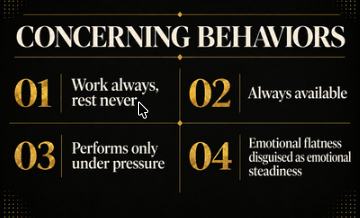
Bohrer lists these the way a physician lists symptoms: never taking a day off, treating sleep like a negotiable line item, staying available at any hour. That last one reads as commitment on a performance review. A leader who performs well only under pressure isn’t showing strength. That leader needs the adrenaline and the company has mistaken a dependency for a virtue.
The hardest warning sign to spot is composure itself. A regulated leader who’s calm under fire and a dysregulated leader who has gone emotionally flat can look the same in a meeting. “One is a resource. The other is a liability in disguise.”
The hardest warning sign to spot is composure itself.
Why Does Pushing Through Feel Like a Winning Strategy?
It works. But it isn’t a strategy you can rely on long-term. “Early success with a bad strategy convinces you that the strategy is sound.” The nervous system has real resilience built into it, so a person can draw against their reserves for months, sometimes years. Along the way they get promoted, praised, and reinforced, which means the feedback they’re getting is precisely backwards.
Bohrer frames the tradeoff in blunt terms. “It is a withdrawal, not a deposit.” Most high performers, in his experience, treat pushing through like income instead of a loan. A person can only make withdrawals for so long before the account collapses. The damage doesn’t show up on a predictable schedule the way it would in a machine. It accumulates quietly, and the most dangerous stretch is usually one where everything still looks fine from the outside, right up until it doesn’t.
How to Reset Your Nervous System
Bohrer’s advice on resetting your nervous system doesn’t start with therapy or a sabbatical. It starts with a full stop, two to three minutes with no phone, no productivity goal, and no agenda besides letting the nervous system register that there’s no threat in the room. “Your body knows.” Bohrer says it will demand a reckoning if it keeps getting ignored.
The mechanics Bohrer teaches are almost absurdly simple. Here’s the process:
Soften your eyes.
Widen your peripheral vision.
Press your thumbnail gently into the pad of your middle finger, which prompts belly breathing instead of the shallow chest breathing most people default to under stress.
Inhale for four counts, hold for two, and exhale for six.
Repeat three times.
Nothing about a person’s workload changes in those seconds. The inbox is still full and the deadline hasn’t moved. What changes is the operating system underneath it, and that’s the only place real capacity ever gets rebuilt.
None of this shows up on a quarterly report. A company can watch its best people make the same withdrawals over and over and read every one of those wins as evidence the strategy works, right up until there is nothing left for their best people to give.
Why Is My Leadership Team Working Harder and Getting Less Done?
Jimmy Burroughes
Jimmy Burroughes, a former military leader who has done performance improvement work inside companies like Samsung, LEGO, and Bank of America, has a blunt read on the executive team that’s busier than ever and producing less: they’re already pulling as hard as they can. The drag is coming from friction nobody has bothered to remove. Piling on bigger goals doesn’t fix that. It gives you a more exhausted team delivering the same output.
The image he uses to describe that point with leadership teams is a rowboat. Everybody’s straining at the oars and facing a slightly different direction. Nobody’s in time with anyone else, the hull is sitting in seaweed, and there’s still a rope tied to the dock. Rowing harder solves exactly none of those problems.
When he asks leaders to identify the lowest-effort, highest-impact item on their to-do list, most of them can’t answer, because they’ve never sorted the list that way. They start at the top, work down, and hope.
What Happens When One CEO Tries to Multitask for the Whole Company?
Burroughes spent about a year and a half with a CEO who carried 20 projects in his head at once. He launched new ones constantly, and dipped his fingers into all of them to make sure they were running well.
His leadership team couldn’t tell what the priority was on any given day. The definition of success moved every week and leaders stopped finishing things because something new kept landing on top of the last thing.
The intervention involved one project per week for the whole leadership team, with every available resource pointed at it. Anyone not involved got the week back to build their own business unit. “Not seventeen things a week, just one.”
Six months into that cadence, every member of the executive team reported getting more done in their own unit because they weren’t carrying the CEO’s overflow. Collectively they’d delivered more than any comparable stretch. Absenteeism dropped, engagement rose, profitability rose, and stress markers moved too: “Cortisol levels were down. We did blood tests on people.”
Here’s the part worth sitting with: while multitasking looked like leadership to outsiders, it felt like chaos in every seat below. That CEO’s habit of touching everything was the single largest source of friction in his own company. It never showed up on any report, because there’s no line item for the cost of a boss changing his mind.
Complexity and Clutter
Burroughes diagnoses overcomplication by walking down the org chart rather than reading the strategy deck. The first tell is employee turnover.
The second tell shows up when he talks to the survivors. They look strung out and can’t name what the team’s priorities are because everything qualifies.
The third tell sits a layer below that, where people say they just turn up and do their jobs. They still care. They aren’t disengaged. They’re rowing without knowing where the boat is headed. Nothing connects their days to anything the leadership team decided. They make reasonable local decisions that pull the boat in directions the CEO never chose. Burroughes traces that straight back up the org chart because a lack of clarity usually gets passed down through the business.
Most of what gets called complexity is an accumulation of decisions that haven’t been made yet. He watched a room of organizational development leaders reach for elaborate, elegant solutions to something none of them had defined yet. The question that kept resetting the room was simple: “Well, what’s the business problem you’re actually trying to solve?”
What Should You Do When the CEO Keeps Adding to Your Plate?
Burroughes gets this question in every workshop. His answer is a set of three gates he calls PVC: purpose, value, capacity. Purpose splits into two questions.
What’s the purpose of this work?
What’s the purpose of me being the one doing it?
The second one is where most overloaded managers get caught.
Executives are usually drowning because they never learned to hand work off, or they don’t trust anyone else with it. His experience is that the CEO rarely meant for them to do it personally. The instruction was to own the outcome.
Value is where he gets specific enough to be uncomfortable. If one project moves $10 million in revenue and another moves $1 million, your energy has an obvious address. Then there’s the value of your own hour, which he calculates by dividing annual salary by 2,080. Call it $50 an hour. If you’re spending that hour on work you could pay someone $15 an hour to do, stocking the supply cupboard or answering social media comments, you’re not doing the high-value work your CEO needs from you. No amount of staying late fixes the arithmetic.
Capacity is the gate almost everybody skips. His tool for it is a conversation, not a spreadsheet. Read to your boss the entire list of what you’re carrying, ask which three matter most to him, and then tell him what you’re going to stop, slow down, or swap to make room.
Follow it with what he calls the three by three by three:
three things achieved this week
three priorities for next week
three things you need from him
Most executives, he says, have no idea what their leadership teams are carrying, which makes the reading of that list the whole point. As he puts it, “Your to-do list should now become the whose-to-do list.”
A senior Amazon leader once laid out the same math for a room of retail executives Burroughes was working with. His day starts at four in the morning and brings between 1,500 and 2,500 emails. Roughly 200 things are going wrong inside them, and about 20 are genuine crises. He can address five.
The skill that keeps him employed isn’t working faster. It’s knowing which fire he shows up for himself and which one gets a junior firefighter, partly because that’s how junior ones learn to fight bigger fires.
Trust Is the Constraint Nobody Puts on the Board
One team Burroughes worked with had been together so long that the newest member had been on the team for four years. And, they still didn’t trust each other. They ran their meetings as a series of status reports from functional heads rather than a conversation about how to run the business. In the room they agreed. Outside it, they undermined each other, protected their own units at the expense of the next one, and positioned for a CEO seat they all assumed would open soon.
The repair started somewhere that sounds too soft to matter. They didn’t know each other. They couldn’t say who had kids, whose kid was disabled, who was allergic to Thai food, who spent weekends making pizza.
From there he pushed decisions into the open, sending the CFO to explain the budget to the marketing team and the sales GM to talk through the pipeline with operations. Finally, managers in operations started asking how they could help sales hit a number that wasn’t theirs. Then came the rule they all signed: “We argue in this room; when we go out, we’re a unified front.”
Constructive conflict inside, one voice outside, in place of the older arrangement where everyone nodded in the meeting and relitigated it in the hallway. It took three or four months of small, cumulative changes, and the culture of the business moved.
A man I worked for years ago told me decisions are only as sound as the facts they’re based on. That’s why trust is an operating issue, not a team-building exercise. If your people can’t tell you the truth without paying a price for it, you’ve trained them to sand the edges off bad news and exaggerate the good news. Every decision after that gets made on a version of reality your own team edited for your comfort.
What Is the Cheapest Way to Get Hours Back This Quarter?
Burroughes teaches one question on day one of nearly every program he runs. It costs nothing to deploy: “What do you suggest?” He closed out a program with a dairy company recently where the group freed up 23.5 hours a week of collective time on the strength of that question alone, just by asking the people who already knew instead of supplying the answer themselves.
His one piece of advice for owners and CEOs follows from it: you’re not paid to be the expert anymore. You’re paid to make good decisions. The fastest route to a good decision is the smartest people you can get in a room and a genuine willingness to use what they say.
A leader who insists on having every answer eventually gets a team that stops offering any. He’ll read that silence as confirmation he was right to answer everything himself.
Competence, Confidence, and the Guts to Speak Up
Tanya Anne Chavez
You keep taking it back, and the company keeps rewarding you for it. Tanya Anne Chavez, a former Air Force jumpmaster who now coaches executives, calls this the superhero leader, the one who charges in, fixes it, saves the day, and then sits exhausted wondering why nobody else carries the load.
Stepping in and fixing the thing yourself is the most comfortable move available to you, since you already know you can do it. Letting someone else carry it is the move that costs you something. Most leaders wouldn’t frame their own heroics as risk avoidance.
What Are Unsaid Ideas Costing You?
Chavez points to work by Karin Hurt and David Dye, who asked thousands of employees whether they were sitting on an idea they’d never shared with their boss. About half said yes. Half of your employees are walking around with something they decided wasn’t worth the risk of saying out loud.
The physical version is familiar to anyone who’s been in a meeting where the wind was blowing one direction. You have something that would change where the discussion lands, you get a pit in your stomach, and you swallow it. Nothing dramatic happens. The meeting simply ends without the contribution that might have made it useful.
What gets me about this is the invoice companies pay instead. The same executive who can’t get candor out of the people who know the business will write a check to a consulting firm to go find out what those people think, then present it back as a finding. The answers were already in the building.
Why Doesn’t the Offsite Fix It?
Chavez has no argument with retreats, escape rooms, or axe throwing. She’ll tell you they build camaraderie. What she’ll also tell you is that they’re treating a surface problem. The effect is motivational where the situation calls for something structural. A day of fun doesn’t reach the thing that made someone swallow their idea on Tuesday.
Her framing is that if a person’s nervous system has concluded it isn’t safe to speak in that room, no group activity is going to overrule it. The Band-Aid holds until the next high-stakes meeting, everyone reverts, and leadership concludes the team is disengaged. The content of the offsite was never the issue.
You can watch the same dynamic run in the other direction when the leader is the source. Chavez worked with a VP his team called the Tasmanian devil. He’d blow into a room, scatter ideas everywhere and let his energy set the tempo. “They would start to confuse movement with momentum.”
Whatever state the leader walks in carrying gets multiplied by everyone in the room. It’s why the temperature at the table is a leadership output rather than an accident.
Which Person in the Room Is Playing It Safe?
Chavez’s own answer to that question took her years to see. She arrived at the Air Force Academy as a painfully shy kid. The academy exists to build leaders, so leadership roles kept getting offered. She kept turning them down with a line that sounded like maturity: she’d lead when it mattered. The job she took instead was morale, welfare, and recreation: planning parties and tailgates, with no squadron to run and no briefings to give.
Then she made the parachute team. Everyone assumed she was brave since she was jumping out of airplanes. Nobody asked again why she kept declining command roles. What she was avoiding wasn’t danger. It was scrutiny and the criticism that comes with a leadership position, a fear she describes as sitting in the bones rather than the head.
Years later, one executive she took through her wind tunnel training was running the same play in a suit. He told her he steps in, fixes things, and his team won’t step up. He couldn’t tell whether they were lazy or unmotivated. “That was his way of playing it safe.” Doing it himself, his way, was the option that couldn’t hurt him.
Ask which behavior in your company is being praised as courage while quietly functioning as avoidance. Is there a founder who won’t hand off the client relationship, a manager who rewrites every deliverable, an executive who takes the hardest problem home rather than delegating it? All of that reads as commitment on a performance review.
Every Person Has a Door
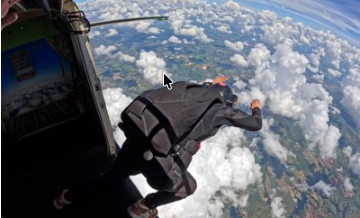
The Air Force Academy is the only place in the world where a first skydive is solo. There are three days of ground training. Then you jump out of a plane at 4,500 feet, get 10 seconds of free fall, and pull your own canopy with nobody attached to you. Almost none of the cadets will ever jump into combat, so the point isn’t the jump. As Chavez puts it, they earn the wings “so they know how to respond when they want to freeze, when they want to run.”
The sequence is designed so nobody gets to bypass the fear. You stand in the door, hands and feet in order, hanging into the wind stream while your body screams that this is wrong, and then you go.
My U.S. Army Airborne School training ran three weeks instead of three days: a week learning to hit the ground without breaking anything, a week on the towers, then jump week. By then, we were executing something we’d drilled a hundred times. Competence produced confidence, which is worth remembering before you throw someone into a role and call it a growth opportunity.
Chavez’s translation to the workplace is that “every person has a door,” a specific edge that feels like stepping into free fall. Most people are still sitting on the plane. They don’t raise a hand, pitch the idea, or ask to run the project they could run. The leader’s job is to know where each person’s door is, which requires knowing them well enough to identify it.
On a jump, the pounding heart makes sense. You expect it, so the fear stays legible. In an office, the same physiology shows up when the inbox stacks up, and nobody calls it fear. They call it stress, a busy week, or just email. Chavez’s instruction is to separate the story from the signals.
What Have You Packed in Your Parachute?
Nobody is meant to free-fall forever, which is the part leaders skip. Free fall is the sympathetic nervous system doing its job. Chavez has no interest in removing it, since that’s where growth happens. The problem is remaining there permanently, courtesy of back-to-back meetings and a phone that never stops, with no mechanism for pulling the canopy and slowing down.
The reserve chute matters too, and it has to be specific to the person. For example, a deep breathing exercise helped one executive regulate their nervous system, but caused another one to start hyperventilating. The person who hyperventilated tested other methods until they found one that worked for them: rubbing their fingertips together lightly enough to feel the ridges. Most people never collect the data on what puts them in free fall or what gets them out, so they carry a parachute packed for somebody else.
Chavez’s standard for anyone running a company is blunt, and she would put it in the job posting: “A regulated nervous system is part of the job description.” You’re paid for clear vision and moving through uncertainty.
“A regulated nervous system is part of the job description.”
Her closing claim is worth testing against your own team: courage is innate. Nobody has to install it. It gets trained out of people by criticism and the fear of looking foolish. That training happens somewhere. It happens at work. The question isn’t how to build courage in your people. It’s how to identify what your company built that keeps taking it out of them.
Problem Solving, Leadership, and Vision
Art Serna
You addressed the symptom and left the system that produces the problem intact. Art Serna is author of The Unknowns Rising and a systems change strategist who has worked across government, nonprofits, healthcare, education, and enterprise growth. He asks one question before he’ll accept the premise that a problem has been fixed: “If you were to solve this problem perfectly, like today, will it come back in six months?” If the honest answer is yes, the work isn’t done and the meeting that declared it done was theater.
Serna has an advantage over traditional industry experts when he works in industries he wasn’t raised in. His read on why that matters: “When you don’t inherit the assumptions of an industry, then you have incredible freedom to question them.”
Twenty years in a sector buys pattern recognition. It also buys rules nobody remembers adopting: why the margin has to be that number, why the sales cycle takes that long, why the product ships in that configuration. Those answers were treated as facts long before most people in the room joined their teams.
What Does an Outsider See That the Room Can’t?
Serna’s example is the one everybody quotes and almost nobody applies. Blockbuster took stores as given and optimized inside that assumption. “Netflix just had a different set of questions. What if you didn’t need stores?” Serna heard the founder of Netflix describe pitching that idea to Blockbuster’s board and being shown the door.
Most companies kill these questions with a phrase rather than an argument: “We tried that. We discussed that already.” The person asking may well be raising something that was wrong three years ago and is right this year. The organization has no mechanism for telling those two situations apart. Nobody checks, because the old answer got filed without a date on it. It just says no.
Companies also routinely mistake volume for judgment. The loudest and most confident voice in the room is not reliably the most competent one. If that’s the voice steering, the quiet person with the better question learns to stop offering it.
How Far Ahead Should You Be Looking?
Serna’s answer runs past the range most strategy decks cover. The underdeveloped executive muscle is the capacity to lead from the future, meaning 10, 20, and 30 years out, then work backward into what the team does now. A three-year plan mostly extrapolates the present, so the leaders writing it never see the disruption coming. They’re forecasting more of what they already have.
For example, he watched this play out in Oklahoma City, where he worked with the school system through Teach for America. At the time, 51% of students came from families outside the demographic around which the system had originally been designed, many of them Spanish-speaking. The system wasn’t serving them well because it was never built to. Demographic change that was visible in the enrollment data was visible a decade earlier in the birth data. Nothing in how they recruited or trained talent had moved to meet it.
He borrows from Chris McGoff’s The Primes and the Three-Horizons framework. The question at the far horizon is the one worth writing on a whiteboard: “What world deserves to exist?” At Spine Hope, the global healthcare nonprofit he works with, that world is one where a child who needs spine surgery can get it. From there, the horizon collapses to something operational, which is what has to happen in the next 90 days to make one decision that moves you toward it.
What frequently gets skipped is interrogating assumptions underneath the strategy already on the page. Serna’s image for this is the group of blind people describing an elephant, each accurate about the piece in front of them and each certain that piece is the animal. A leader committed to one version of the truth gets answers that are less useful, not because the people around them are wrong, but because nobody assembled the whole animal.
Looking Ahead: Decisions About People and AI
Serna’s warning for CEOs pushing AI adoption for efficiency right now is that this could become death by a thousand cuts, and the cuts won’t announce themselves. For example, if you eliminate entry-level positions in favor of AI, then you’ve eliminated the mechanism that trained everyone above them. The savings land this year and the missing bench shows up three years later, when there’s nobody to promote and no cheap way to fix it.
Executives also tend to assume that a Gen Z hire arrives fluent in whatever technology matters. Serna brought data from America’s Promise Alliance, covering 1,500 young people, to a room of manufacturing CEOs. Only 30% of them found AI helpful in their lives. The other 70% didn’t yet see the benefit, and very few used it daily in any meaningful way.
Schools are part of why. High schools across the country are telling students not to use these tools, sometimes for defensible reasons. Almost nobody is teaching them to create value with the tools against a real business or community problem.
Resistance to Change and the Status Quo
Serna’s sharpest observation is about how both corporate and social systems defend themselves. “We only do enough good or allow enough change to make ourselves sleep better, but not enough change to fundamentally disrupt the assumptions underneath the current system.” His example is an education system graduating students who can’t read while everyone involved tolerates it.
My version of the same idea: the pain is never too great for the people who don’t have to feel it, the price is never too high for the people who don’t have to pay it, and the risk is never too great for the people whose necks aren’t on the line. Ask who in your company is insulated from the consequences of the problems, or worse, benefiting from the problems that repeatedly go unsolved, and you’ll usually find the reasons the problems persist.
What Should You Audit Before the Next Strategy Session?
Asked for one piece of advice for owners and executives, Serna goes somewhere most strategists don’t. “What is your definition of what human flourishing should look like in your lifetime?” He built his own answer by reading back through decades of his leadership and personal journals looking for patterns. What surfaced was family, hard work, and a permanent commitment to learning, which now determines what challenges he takes on and which ones he turns down.
Flourishing, for example, can sound abstract until you connect it to something like hiring, which is where it earns its place. Serna’s read on the young leaders he mentors is that “They’re not just going to stay for salary.” They’re weighing whether a job puts them near the decisions that shape what comes next. A company that can only offer money is competing on the one dimension where somebody bigger always wins.
Purpose has become a slide in most companies, which is precisely why the exercise still works when someone does it seriously. Strategy answers how you get from A to B. It has nothing to say about why B is worth reaching.
“What is your definition of what human flourishing should look like in your lifetime?”
COVER STORY: Actions, Examples, and Outcomes
Kyle McDowell
Accountability systems are built to catch failure, which doesn’t produce anyone’s best work. Kyle McDowell is a former Fortune 10 executive who spent nearly three decades running large teams and billion-dollar operations.
He makes the case that most of what companies call an accountability problem is a leadership problem by another name. Ownership is what drives performance, and people take it on only when their leader gives them a reason.
I once asked a client with a $10 million payroll what he figured the discretionary effort of his average employee was. He said 60%, which, as a simple illustration, meant a $10 million annual payroll buying roughly $6 million worth of work. I asked how fast he’d move if someone were embezzling $4 million a year from him. Same day, he said. Nobody had ever told him the shortfall was a number he could look at.
To his credit, he put the same question to his frontline supervisors that afternoon. They said 35% to 40%. That gap is one worth taking apart. McDowell watched it form inside very large companies, where talented people end up “focused on doing just enough to stay out of trouble instead of doing their best work.”
What’s the Difference Between Accountability and Ownership?
McDowell doesn’t believe a leader can create accountability, and he’ll tell you the word has been ruined by how bosses use it. Most of them confuse it with punishment, so the whole apparatus ends up pointing at people instead of equipping them. “Accountability is not about catching people doing something wrong.” It’s about setting expectations clearly enough that a person can tell whether he hit the mark.
His example is a barista in a small coffee shop, a job that appears to offer little room for ownership. You can take the order, fill the cup, slide it across the counter and be fully compliant with every expectation the role carries. You can also decide to have some effect on the person’s day. The difference between those two versions of the same eight hours isn’t effort. It’s having a reason to care beyond the task itself. Strong performers want that reason badly enough to go hunting for it in a job that appears to offer none.
No leader can install ownership, schedule it, or write it into a performance improvement plan. It’s something people pick up on their own. The only lever available is the environment, and the leader owns that lever whether or not he admits it.
Why Can Every Employee Do the Job Perfectly and Still Fail the Guest?
Last month I spent a day in 100-degree heat getting a house in Kansas ready to sell. By dinner I wanted a real meal, so I picked a Mexican restaurant at roughly twice the price of the less expensive restaurants nearby. Every employee did the job right. The host seated me fast, the server checked on me every 15 minutes, the food was excellent, and the tables were spotless.
I was dehydrated, so my water was gone in about a minute. The empty glass then sat at the edge of my table for five to seven minutes. At least five employees walked past it, some of them twice, until I gave up and got a refill at the bar myself. I sat back down, drank that one, and made the same trip again.
Every one of them executed tasks perfectly and the team still failed. Nobody owned the guest experience, only a slice of it. Their identity was wired to a job description and they all chose to stay in their lanes.
The same failure runs at far larger scale inside big companies. Functional silos can each perform well against their own metrics while the overall customer experience remains mediocre. One area takes real pride in its numbers and has no idea what’s happening two functions over.
One of McDowell’s “Begin With We” principles mentioned in his book is, “We take action.” He sets the bar low on purpose: taking action doesn’t mean doing someone else’s job. In the example I just gave about the Mexican restaurant, it means the bartender could have told the server that the guests at table seven have been without drinks for a while. If that expectation doesn’t exist, something else fills the gap: “Not my job, man.”
Culture Starts With Identity, Not a Values Statement
The 10 principles McDowell built his book around didn’t begin as principles. They began in a hotel room in Lawrence, Kansas, the night before he had to stand in front of the top 40 or 50 leaders of a 15,000-person organization he’d joined weeks earlier.
What he worked through that night was a question of company identity. He ran through the leaders who had made his first 20 years miserable and decided, “That’s not who we’re going to be.” He ran through the handful who saw more in him than he saw in himself and decided, “That’s exactly who we’re going to be.”
Behaviors came afterward, as a way to describe a team he had already chosen to build. A company that writes the values first and hopes an identity forms around them has the order backward. Everyone inside can feel it.
That’s another one of McDowell’s principles, “We lead by example.” He frames it as a question with no opt-out. The question isn’t whether you’re leading by example. It’s whether you’re leading by one you’d be proud to see copied. He’s blunt about why the poster in the lobby never worked. “Nobody cares about the values on the wall.”
Employees watch behavior instead, checking whether you’re a hypocrite. The moment that counts most is the one where you break your own standard and say so out loud.
What Should You Do First When You Inherit an Underperforming Team?
Within his first month at that same 15,000-person company, McDowell’s boss named two people on his team who needed to go. New leaders almost always comply, since pleasing the boss is the fastest win available. Swinging a sledgehammer photographs well as decisiveness. McDowell’s question was one nobody asked: why were these two still on the payroll for him to deal with if they were that bad?
His sequence is change the environment before changing the people. Listen first, ask fewer questions than you want to, and observe. Set the standards everyone will operate by, the leader included, before saying a word about the metrics.
Then go get some quick wins and publicize them, because a team known for low morale already knows what it’s known for. “People don’t need promises. They need evidence that you’re not just there to supervise. You’re there to actually lead.”
Some people do have to go. McDowell isn’t sentimental about that. What he insists on is sequence, meaning the decision comes after you understand why the numbers sit where they sit. People who look like they don’t care have usually been taught that caring bought them nothing, and somebody in the building did the teaching.
Are You Rewarding Outcomes or Theater?
Another one of his principles reads “We measure ourselves by outcomes, not activity.” The tell is a calendar packed back to back, double-booked five times. “People wear that busyness as a badge of honor.” Activity matters, though only when you can draw a straight line from it to an outcome somebody owns. Where that line can’t be drawn, the activity has earned scrutiny rather than applause.
The second tell is harder to see and worse news. When the people who used to push back go quiet and meetings start producing broad agreement with whatever the boss said, the incentive structure has been teaching a lesson. Looking productive pays better than delivering. A company has started buying theater. Nobody is arguing against hard work here, only hard work aimed at the wrong things.
The Question That Cost Him a Promotion
In 2009, McDowell was running an organization of about 5,000 people when a peer left the company. McDowell’s boss asked him to absorb the departing peer’s group on top of his own. Roughly a month later, the boss left too, which put his job on the market. By then, McDowell was running two of the three groups that job covered, and he considered himself the obvious successor. He interviewed for it and didn’t get it.
In his next one-on-one, he asked the division president why. The answer came back in five words: “You never asked for help.” The inherited function was underperforming in a domain he barely knew. He had never raised his hand for resources, expertise, or anything else, because he thought owning it meant carrying it alone.
That’s the one piece of advice he’d give if he could give only one. It costs so much because the instinct running against it feels like professionalism. Executives learn early that the room rewards whoever seems to have the answer. The person who could most afford to say “I don’t know” is the one who never says it. The team that most needs to hear it never does.
A leader who asks for help in front of his team is doing something more valuable than solving his own problem. He’s showing everyone below him what’s permitted. The cost of not asking for help extends beyond a missed promotion. It’s an organization where nobody else asks either.
“People wear that busyness as a badge of honor.”
Extreme Endurance and Difficult Business Goals
Neil Thubron
Pressure has a way of making bad management look temporarily reasonable.
Sales are slipping. The forecast is weak. Investors want answers. Customers are hesitating. Suddenly, more meetings appear on the calendar. Reporting increases. Managers demand daily updates. People who should be solving the problem spend their time explaining the problem.
It feels like control. Usually, it is fear wearing a management title.
My conversation with Neil Thubron reinforced something I have seen in very different environments: corporate sales organizations, military leadership, and endurance events. When conditions deteriorate, the instinct to tighten control can be exactly what makes performance worse.
Thubron has spent more than 25 years leading multinational sales organizations and has also tested his thinking in environments where consequences become very tangible. His experiences include military service, offshore sailing, Ironman events, the Ultra-Trail du Mont-Blanc, and the Yukon Arctic Ultra.
The common thread is not toughness. It is knowing what requires control, what requires adaptation, and what must be entrusted to other people.
What Should a CEO Do When the Team Is Under Pressure?
The first job is not to manufacture certainty. It is to provide direction.
Thubron described an offshore sailing race from northeast Australia to China. The crew faced changing winds, storms, rough seas, and conditions that sometimes required sailing away from the destination before coming back on course. The destination did not change.
Executives often confuse commitment to a destination with commitment to the original route. When conditions change, they either cling to a plan that no longer works or change direction so frequently that employees stop believing there is a direction at all.
A CEO needs to be firm about where the organization is going and flexible about how it gets there. That does not mean standing in an executive suite repeating the vision while everyone else deals with the consequences.
Thubron made another distinction I think is equally important: being close to the work does not require taking over the work. On a yacht in a storm, the skipper may need to remain at the back of the boat because that is where the whole situation can be seen. If the skipper rushes to the bow and starts doing someone else’s job, the crew may gain another pair of hands but lose the person with the broadest perspective.
Executives face the same problem. They need enough contact with employees, customers, and operating conditions to understand what is really happening. They don’t need to become the salesperson, engineer, customer service representative, or operations manager every time pressure rises. There is a difference between being present and interfering.
Empowerment Is Easy Until Employees Choose Differently Than You Would
One of Thubron’s earliest leadership lessons came at IBM when he participated in an experiment involving empowered teams. A supervisory position opened on his team. Under the traditional model, he would have selected the replacement. Instead, the employees interviewed the candidates and made the decision.
Thubron had someone in mind. The team chose someone else. More importantly, they were right.
That is where most conversations about empowerment become uncomfortable. Executives tend to like empowerment when employees arrive at the decision management would have made anyway.
That is not empowerment. It is delegated agreement. Real empowerment means accepting that the people closest to the work may see something the executive doesn’t.
The IBM team eventually became sufficiently self-directed. Employees participated in decisions involving pay increases and promotions, with Thubron facilitating rather than dictating the outcomes.
The executive implication is straightforward. If every meaningful decision still requires approval from above, the organization has not created accountability. It has created dependency.
Why Does Pressure Turn Some Managers Into Bullies?
Fear often travels downhill. Thubron sees this particularly clearly in high-pressure sales organizations. When a senior executive becomes anxious about missing a number, that anxiety can quickly turn into demands for more forecasts, more updates, more meetings, and more explanations.
He described one sales executive whose team was behind forecast. The response from above was to require daily pipeline explanations, including a Saturday review.
The absurdity is easy to miss because the activity looks serious. Customers were not advancing deals on Saturday. The sales leader was not selling. His team was not selling. They were gathering information and building slides to explain why they were not selling enough.
The reporting mechanism designed to improve performance was consuming the time required to improve performance. That is one of the hidden costs of fear-based management. It does not merely damage morale. It redirects productive capacity toward managing the anxiety of people higher in the organization.
Executives should pay attention whenever reporting frequency suddenly increases after results decline. Some additional visibility may be necessary. But there is a point at which oversight stops helping the business and starts helping senior management feel temporarily safer.
How Do You Turn a Big Goal Into Something People Can Execute?
Thubron developed what he calls the 7P Formula while competing in the Yukon Arctic Ultra. The framework later became the basis of his book, Yucan: Achieve Any Big Goal Using the 7P Formula for Success. His seven elements are Purpose, Preparation, Plan, Pledge, Perception, Pain, and Persistence.
What interests me about the framework is not the terminology. It is the sequence.
Purpose comes first because a difficult objective needs a reason strong enough to survive difficult conditions. Thubron separates that purpose into an internal reason and an external one.
The internal reason gets someone started. The external reason can keep someone moving when personal motivation becomes negotiable.
That distinction applies directly to business. Revenue growth alone may be an objective, but what does achieving it make possible for employees, customers, or the organization? When the work becomes difficult, a number on a spreadsheet has limited emotional weight.
Preparation comes next. Thubron’s point is more specific than simply “be prepared.” Preparation should resemble the conditions people will actually encounter.
Then comes the plan, followed by the pledge: the point at which an intention becomes a commitment.
The fifth “P” is perception. It may be the most valuable for executives. A plan is necessary, but the plan does not get a vote once reality arrives.
During the Arctic event, Thubron initially planned to move for three hours before stopping. He discovered quickly that the interval was too long and changed his approach to two-hour segments followed by short breaks.
The destination remained intact. The method changed because the evidence changed.
Organizations often do the opposite. They defend the plan because changing it feels like admitting the original decision was wrong. That is an expensive form of pride.
Resilience Doesn’t Mean Working Until Something Breaks
Corporate culture has badly distorted the meaning of resilience. Thubron regularly encounters executives who treat resilience as the ability to arrive earlier, stay later, absorb more pressure, and expect employees to do the same. He described that as essentially a strategy of continuing until something breaks.
An ultramarathoner does not prepare for a difficult race by assuming nothing will hurt. The athlete expects problems and develops responses before judgment becomes impaired by exhaustion. Thubron calls this a pain strategy.
During his Arctic race, music was part of his. He deliberately associated particular music with a strong mental state during preparation so it could help him recover that state when conditions became difficult.
In business, the equivalent may be knowing who to call when judgment is deteriorating, protecting physical routines that support decision-making, or identifying in advance how the team will respond when an important deal, employee, or assumption disappears. The point is not to eliminate pain. The point is to avoid inventing the response while you are already inside it.
The People Around You Can Increase or Reduce Your Odds of Success
Anyone who has spent enough time around endurance sports learns that encouragement is not always helpful. Sometimes the person saying, “You have nothing left to prove” is giving an exhausted athlete the permission to quit that they were subconsciously waiting for. Business has its own version of that problem.
When something goes wrong, executives need people who can distinguish between a genuine reason to stop and the predictable discomfort of continuing. That does not mean surrounding yourself with people who mindlessly demand more effort. It means finding people capable of accurately diagnosing the situation and offering valuable assistance. There is a substantial difference between sympathy and useful perspective.
You Don’t Need Cheerleaders
The best advisers, colleagues, and executive teams do not simply reinforce how the CEO already feels. They aren’t cheerleaders.
They help determine whether the organization is injured or merely hurting. One requires intervention. The other may require another step.
Pressure does not suddenly make someone a better leader. It reveals the habits that were already there. Executives who respond to uncertainty by centralizing decisions, demanding constant updates, and driving people through fear may create the appearance of urgency while making the organization less capable of responding.
The alternative is not softer management. It is more disciplined management: a clear destination, informed preparation, distributed judgment, accurate perception, and enough persistence to keep moving forward.